

If you live in New Hampshire and drive to a job across the border, your employer will often withhold Massachusetts tax on all of your pay, including the days you worked from home. It is one of the most common situations we see in Southern New Hampshire, and people here routinely pay more Massachusetts tax than they owe. Only the days you were physically in the state are taxable there, and the difference is claimed back when you file.
Which state taxes my paycheck, New Hampshire or Massachusetts?
New Hampshire has no income tax on the money you earn from a job. Massachusetts does tax wages, but only the pay you earn for work done inside its borders.
So if you live in New Hampshire and commute to a job across the border, Massachusetts is the only state that taxes your paycheck. It taxes the part you earned on the days you were physically there.
New Hampshire’s other taxes rarely reach a commuter. The Interest and Dividends Tax was repealed effective 2025, so New Hampshire no longer taxes investment income either, though a 2024 or earlier return can still carry it. If you run a business, the Business Profits Tax and Business Enterprise Tax begin once you pass their thresholds, and the small business tax guide covers those.
“He was professional, cordial, and efficient. I'm extremely glad I found NH Tax Advisors and chose to work with them.”
Which Massachusetts return do I file?
A nonresident return is what you file in a state where you work but do not live. Massachusetts calls its version Form 1-NR/PY, and the same form covers part-year residents. If you live in New Hampshire and drive into Massachusetts for work, that is the form you file.
Massachusetts charges 5% on the wages you earned inside the state. There is no second return to file, because New Hampshire does not tax that income. Nothing gets reconciled between the two states either, since only one of them has a claim on the money. You can file electronically, which is the faster route when a refund is due.
You have to file once your Massachusetts income passes a certain amount. That amount is $8,000, or your personal exemption after it is scaled down to your Massachusetts share, whichever is smaller. If you came in under that amount and your employer still withheld Massachusetts tax, file the return. Filing is how you claim the withholding back.
The Department of Revenue publishes the official rules for this return in its guide to personal income tax for nonresidents, which sets out the filing threshold, the deduction and exemption ratio, and what a nonresident may claim.
How does Massachusetts count my workdays?
Massachusetts looks at where you were when you did the work. A day at your employer’s office in Boston is a Massachusetts workday, and the pay for it is taxable there. A day at your kitchen table in Bedford belongs to New Hampshire, and that pay stays out of the Massachusetts figure.
So a hybrid schedule splits your salary. Three days a week in the office and two at home puts about 60% of your pay in the Massachusetts column.
Days you were not required to work never enter the count. Weekends, holidays, vacation, sick time, and leave with or without pay all come out, and what is left is the number of days you actually worked that year. Your Massachusetts share is the office days divided by that number.
A split day usually goes to Massachusetts. The regulation treats a day worked partly in the state and partly outside it as a Massachusetts day unless you can prove you worked outside Massachusetts for more than half of it (830 CMR 62.5A.1(5)(a)), and the Form 1-NR/PY worksheet instructions state it more simply, that any part of a working day spent inside the state makes it a Massachusetts day. Drive in for a morning meeting and work the afternoon at home, and the day stays in the Massachusetts column unless you can show where the hours went.
To see your own numbers, our live in NH, work in MA tax calculator builds the day count from your salary, weekly schedule, and time off, and shows what your withholding may have overpaid.
Can Massachusetts tax my remote days?
No. Massachusetts taxes the days you work inside the state, and a day at your desk in New Hampshire is not one of them.
The question is worth asking, because for eighteen months the answer was yes. A temporary pandemic regulation, in force from March 10, 2020 to September 13, 2021, taxed New Hampshire residents on days they worked at home for a Massachusetts employer. New Hampshire took it to the United States Supreme Court, which declined the case in June 2021, and the regulation expired that September with nothing put in its place.
Massachusetts also has no convenience-of-the-employer rule, the kind New York uses to tax remote days worked outside the state. Sourcing went back to physical presence, and New Hampshire passed a law in 2023 opposing the taxation of its residents’ remote work by other states. We check the Massachusetts position each season before a return is prepared on it.
Do I use the apportionment worksheet on line 13?
Usually not, though it looks like it was built for you. The worksheet on line 13 of Form 1-NR/PY asks how many days you worked outside Massachusetts, how many inside, and how many were weekends, holidays, vacation, or sick leave. If you have been counting office days, this looks like where that count belongs.
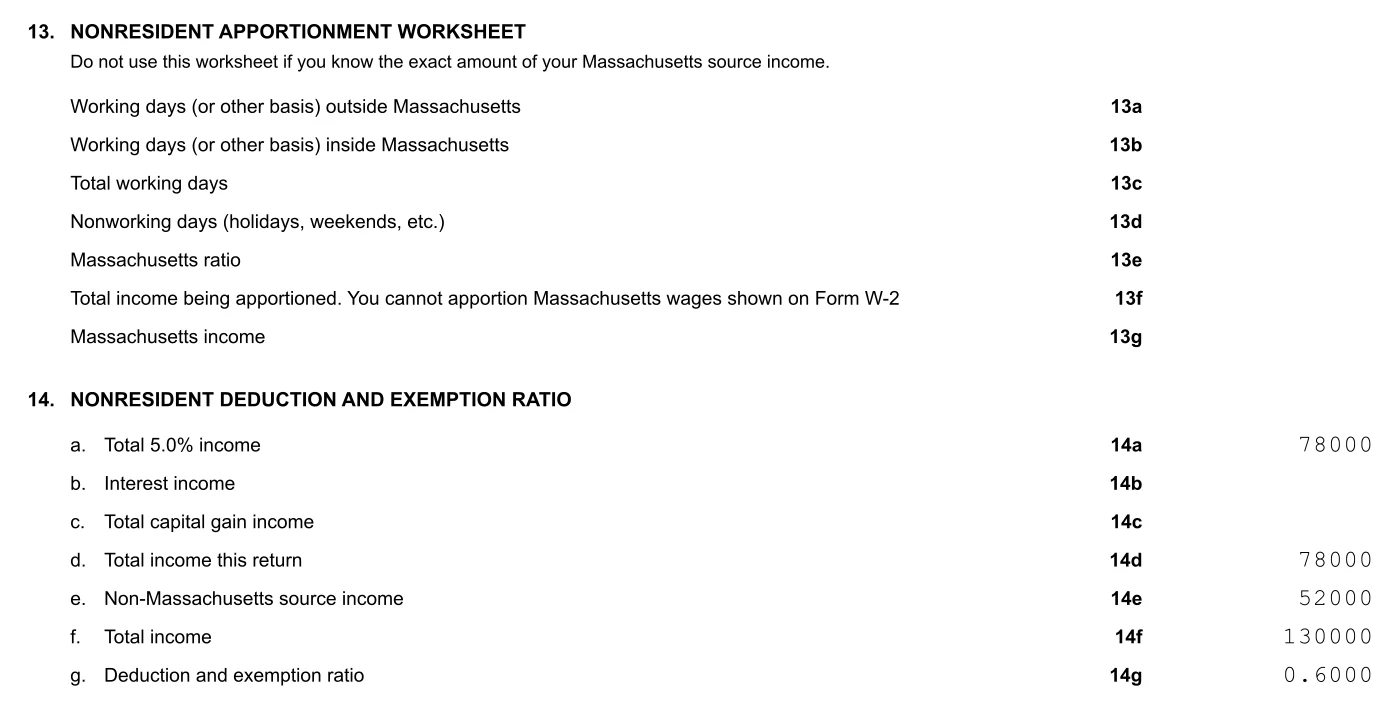
It is built for a narrower group. The note at the top says not to use it if you know the exact amount of your Massachusetts source income, and line 13f says the wages reported as Massachusetts on a W-2 cannot be apportioned. The regulation puts it the same way: where an employee can establish the exact pay received for services performed in Massachusetts, that amount is the Massachusetts source income (830 CMR 62.5A.1(5)(a)). So once you can establish what you earned on your Massachusetts days, that figure goes on line 5 rather than through the worksheet.
Line 14 is a different calculation, and every nonresident completes it. It sets how much of your deductions and exemptions you can claim, since Massachusetts limits both to your share of the income earned there. Line 14e asks for everything you earned from sources outside Massachusetts, so the pay for your New Hampshire workdays goes there along with the rest of your non-Massachusetts income. Where your federal total income comes out more than 10% above the figure on line 14f, the instructions ask for a statement explaining the difference, and we enclose one as a matter of course.
| Your situation | Line 13 worksheet | Line 14 ratio |
|---|---|---|
| Your W-2 shows only the pay you earned inside Massachusetts | No. Report that figure | Yes |
| Your W-2 shows your full salary as Massachusetts wages, but part of your work was done in New Hampshire | No. Establish the correct amount and report that | Yes |
| You work both inside and outside the state, you are paid by the hour, day, week, month, or mile, or on commission, and you cannot establish what you actually earned in Massachusetts | Yes | Yes |
Why does my W-2 show my entire salary as Massachusetts wages?
Most payroll systems withhold Massachusetts tax on the full salary regardless of where the work was done, so the W-2 that arrives in January reports every dollar as state wages. Nothing on a pay stub shows it during the year, and most people find out when the return is prepared.
Check the state boxes along the bottom of the form. Box 16 is your Massachusetts state wages, and box 17 is the tax withheld on them. If box 16 matches box 1, your employer treated all of your pay as Massachusetts income.
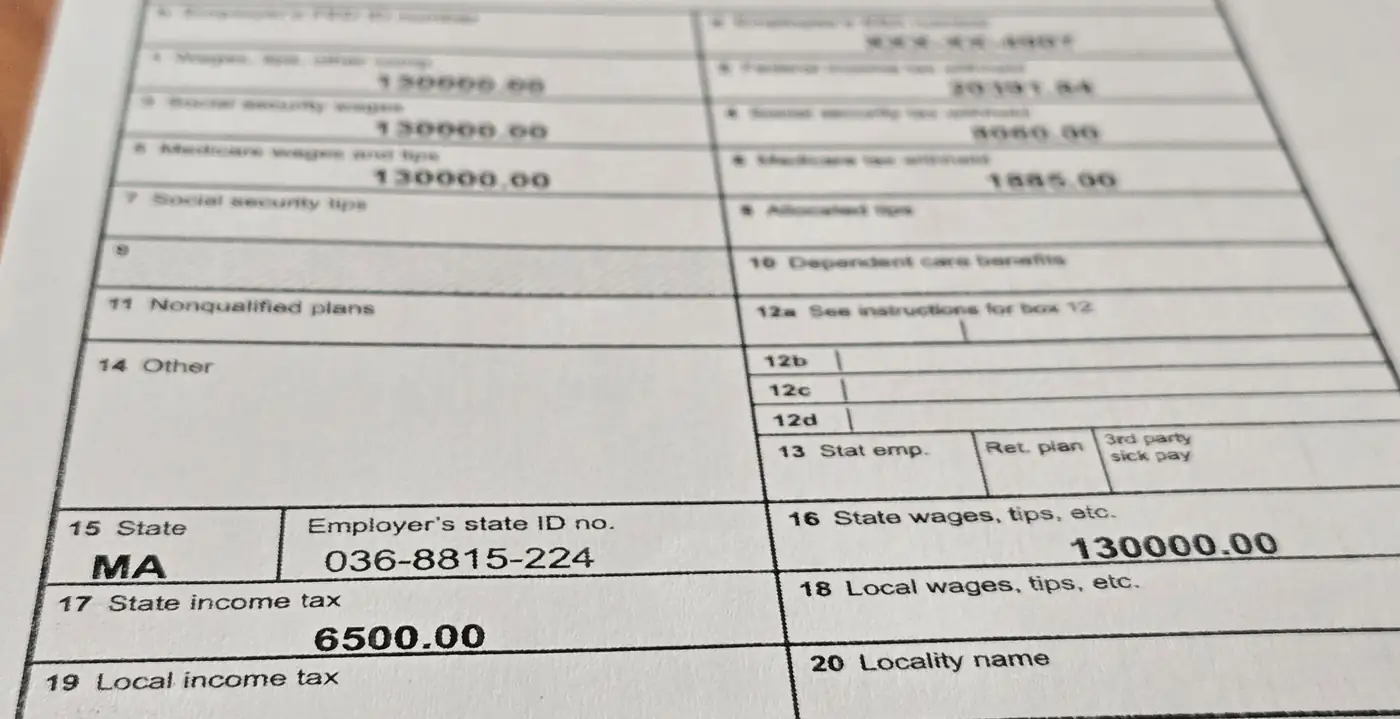
The adjustment goes on Form 1-NR/PY. Line 5 carries the wages earned on your Massachusetts workdays rather than the box 16 amount, and line 42a still claims the full box 17 withholding. We enclose a statement showing how the day count was built.
Example: Three days in the office, two at home, and $2,600 overpaid to Massachusetts
The numbers here are an illustration. Salary of $130,000, three days a week at a Waltham office and two at home in New Hampshire. Take out 135 nonworking days (weekends, holidays, vacation, and sick days) and 230 working days are left: 138 in Massachusetts and 92 in New Hampshire. That puts 60% of the work inside the state.
| Massachusetts wages shown on your W-2 | $130,000 |
| Massachusetts tax withheld at 5% | $6,500 |
| Wages you actually earned in Massachusetts (60%) | $78,000 |
| Massachusetts tax on $78,000, before deductions and exemptions | $3,900 |
| Overpayment before deductions and exemptions | about $2,600 |
The return reports $78,000 as the Massachusetts wages and takes credit for the full $6,500 withheld. Line 14 then prorates the deductions and exemptions, which lifts the overpayment above $2,600. Your own figures will differ with the schedule you worked, the deductions you claim, and the rest of your household income. Put your own numbers into the day-count calculator to see where they land.
If your W-2 reports your full salary as Massachusetts wages, that figure is worth a second look.
If a year you already filed was prepared on the box 16 figure, the correction is an amended Massachusetts return, supported by the same day count and statement. Massachusetts accepts one within three years of the date you filed the original return, two years from an assessment, or one year from a payment, whichever is later. A year older than that can still be corrected on the record, though the overpayment is no longer refundable.
What records prove my Massachusetts workday count?
Your day count decides how much Massachusetts tax you owe, and if the state questions it, proving it is your job. The question tends to arrive two or three years after the year it asks about, once the employer has purged the badge records and nobody remembers which Tuesdays were office days.
Your employer’s documentation carries the most weight. A badge or building-access report lists the exact dates you were in the Massachusetts office, and timekeeping data, payroll location fields, and the written hybrid policy or assigned office schedule all support it. Your own calendar comes next, then travel evidence for the days in question, such as tolls, transit charges, or mileage. Your holiday, sick, and vacation totals need support too, since they set the figure your Massachusetts days are measured against.
The records stay in your file rather than going in with the return, so what matters is that they still exist when asked. A calendar kept as the year goes is worth more than one rebuilt afterward, though for a past year a reconstructed count is usually all there is, and it can still support what you report.
Should I ask payroll to change my Massachusetts withholding?
When your employer withholds Massachusetts tax on your full salary, the overpayment sits with the state until you file, which can be more than a year after the paycheck it came out of.
Massachusetts withholding follows where the work is done, so if your schedule is settled, payroll can often be asked to withhold on the Massachusetts share alone. That raises your take-home pay through the year rather than at filing time. Large multi-state payroll systems frequently keep withholding on the full salary, and the difference is claimed on the return instead.
Changing it carries a risk. If your company revises its hybrid policy or a project puts you in the office more often than planned, too little will have been withheld and you will owe when you file.
What income does Massachusetts not tax?
Massachusetts taxes a nonresident on income connected to a trade, business, or employment carried on in the state, on lottery and wagering winnings from there, and on real estate and tangible property located there. Your interest and dividends fall outside that unless they come from Massachusetts business activity or property, which leaves an ordinary brokerage account untouched.
Social Security and interest on United States obligations are also outside it. So are distributions from a qualified plan, a 401(k) or a pension, which federal law protects from taxation by a state you do not live in. That holds even when every dollar in the account was earned in a Boston office.
How does Massachusetts tax my bonus, commissions, and stock?
A bonus belongs to the work it rewards, so it splits the way your salary does. That covers the bonus paid in January for last year’s work, because the instructions source compensation to where the activity was carried on regardless of when it is paid.
Commissions use a different measure. Where your pay depends on sales, the Massachusetts share is your in-state sales measured against total sales rather than a day count.
Stock compensation is harder. Shares are sourced over the period they were earned rather than to the date they vest, which for a cross-border worker usually means several years of mixed workdays. Two federal problems come with them: the flat 22% supplemental rate under-withholds anyone whose marginal rate is higher, and the broker’s Form 1099-B often reports a cost basis that leaves out the amount already taxed on your W-2. We reconcile those so the same shares are not taxed twice.
Should we file jointly or separately when one spouse works in Massachusetts?
If you file a joint federal return, from 2024 you generally have to file jointly in Massachusetts too. The exception matters here: where the spouse without Massachusetts income has Massachusetts gross income of $8,000 or less, that spouse has no filing requirement and the couple can choose married filing separately for the state. Married taxpayers cannot file as single in either case.
The choice changes what you pay, because a joint return puts both incomes into the line 14 ratio. Your New Hampshire spouse’s earnings go into the denominator, which lowers the ratio and shrinks the prorated exemptions and deductions with it. Whether that helps or costs depends on the two incomes, so the return is worth calculating both ways. The instructions say the same, suggesting a taxpayer figure the tax under each status and take the better result.
Example: The same commuter, two different household incomes
One spouse earns $120,000 working in Massachusetts. The other works entirely in New Hampshire. Only the personal exemption is shown, at the 2025 amounts of $8,800 joint and $4,400 separate.
| NH spouse earns $80,000 | NH spouse earns $200,000 | |
|---|---|---|
| Massachusetts-source income | $120,000 | $120,000 |
| Total income in the line 14 ratio | $200,000 | $320,000 |
| Line 14 ratio | 0.6000 | 0.3750 |
| Exemption on a joint return | $5,280 | $3,300 |
| Exemption on a separate return | $4,400 | $4,400 |
| Better result | Joint | Separate |
The exemption swing is $880 in the first column and $1,100 in the second, worth roughly $44 and $55 in tax at the 5% rate. The same ratio also prorates Schedule Y deductions, including student loan interest, charitable contributions, and the commuter deduction, where the amounts at stake can be considerably larger than the exemption itself.
With one spouse across the border, ask us to calculate the return both ways.
Where it gets complicated
Cross-border returns depend on the details: which basis the wages should be reported on, what the withholding assumed, stock vesting across a multi-state work period, and years with a job change or a move. This is the work we do most.
The right answer varies with your facts, so treat this guide as background rather than a conclusion about your own return. Read about our NH residents working in MA service, or call and we will work out how yours should be filed.
Frequently asked questions
Do I get taxed twice, once by New Hampshire and once by Massachusetts?
No. New Hampshire does not tax wages at all, so only Massachusetts taxes your pay, and only the part you earn working inside Massachusetts. There is no second state return to file and no credit to claim.
Is there a tax agreement between New Hampshire and Massachusetts?
No, and none is needed. Massachusetts taxes wages for work done inside the state, and New Hampshire does not tax wages at all. The two states never tax the same dollar.
Do I have to file a Massachusetts return if I earned less than $8,000 there?
You have to file once your Massachusetts income goes over $8,000, or over your personal exemption scaled down to your Massachusetts share, whichever is the smaller number. If you earned less than that and your employer still withheld Massachusetts tax, filing is how you claim that money back.
Can I still e-file my return when I adjust for out-of-state workdays?
Yes. Nothing about reporting Massachusetts wages different from box 16 of your W-2 forces a paper return, though some preparers still mail these out of habit. Massachusetts requires the opposite: a preparer who filed more than 10 Massachusetts returns last year must e-file yours unless you direct paper in writing and sign Form EFO.
Do vacation days, holidays, and sick days count in the Massachusetts day count?
No. Only days you were required to work go into the count. Weekends, holidays, sick days, vacation, and paid or unpaid leave are nonworking days, and they stay out of the math entirely.
I split one day between the Boston office and home. Which state gets that day?
Usually Massachusetts. A day worked partly inside the state and partly outside it counts as a Massachusetts day unless you can prove you worked outside Massachusetts for more than half of it (830 CMR 62.5A.1(5)(a)). The Form 1-NR/PY worksheet instructions state it more simply, that any part of a working day spent inside the state makes it a Massachusetts day.
Can my employer stop withholding Massachusetts tax on my New Hampshire days?
Often yes. Massachusetts withholding follows where the work is done, and payroll can usually be set to your Massachusetts share once you ask. Large multi-state payroll systems frequently keep withholding on the full salary, and the difference is then claimed on your return.
Is my bonus fully taxed by Massachusetts?
Only in the same proportion as the work it rewards. If 70% of your workdays were Massachusetts days, roughly 70% of the bonus is Massachusetts income. That includes a bonus paid in January for last year's work.
Do I need to pay Massachusetts estimated taxes?
Only if you expect to owe more than $400 that withholding will not cover. Payments go through MassTaxConnect or Form 1-ES, in four installments due April 15, June 15, September 15, and January 15. Most commuters paid on a W-2 have more than enough taken out, so this matters mainly for self-employed people working in Massachusetts.
Do I send my day-count evidence in with the return?
No. A statement showing how the day count was built goes with the return, and the records behind it stay in your file until Massachusetts asks for them. Your employer's building or badge access log is the strongest of those records, and many companies purge theirs after a year, so ask for a copy in the middle of the year and another one in January, and keep both.